Tree risk cases 2 – A mature Aleurites molucanna with pruned roots and an open cavity
Background
The concerned tree is a mature tree of species Aleurites moluccana with DBH of 680mm, Height of 13.0 m and crown spread of 8 m. The tree is located at a raised planter adjacent to 2 buildings. The targets of tree failure include the 2 buildings of constant use, the gathering place and pedestrian road below the tree, which are occupied by the residents and people passing the area of frequent use.

Main defect one – pruned roots and restricted root zone
The tree is a retaining tree located at a re-constructed public housing estate. Before development, the tree is located at a planter with planting area of about 6m x 5m. The old planter structure was demolished and some of its roots were cut to allow space for installing the underline utility such as water and sewage pipe as well as electricity wire and a new planter with size about 4m x 4m was constructed to host the tree. The record of root pruning reported that several roots with size of about 25mm to 50mm were cut and no large structural roots larger than 50mm were damaged.
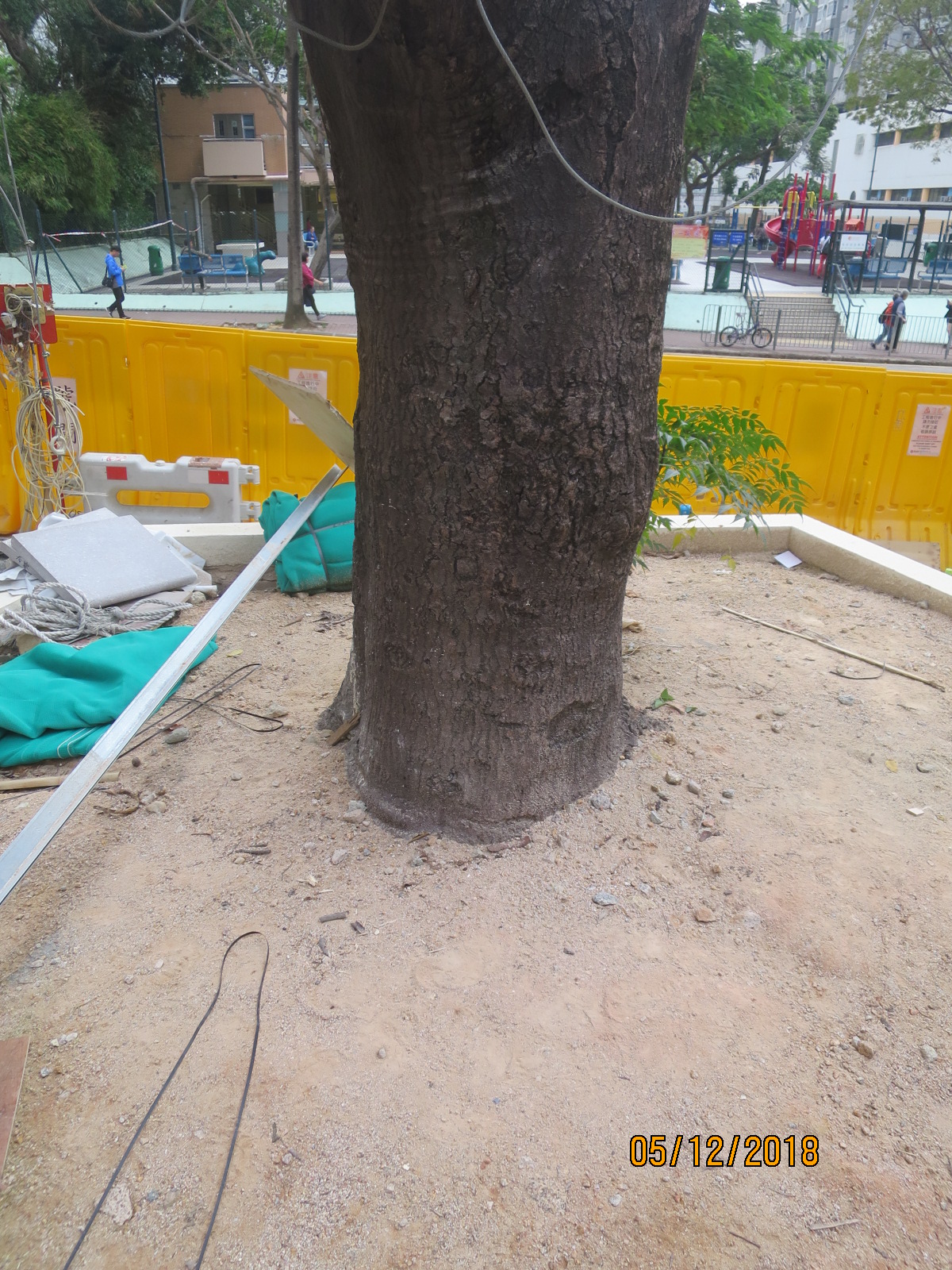
From the field observation, the foliage density is lower than normal and the foliage size is also smaller. These are the common symptom of root damage and more probably relate to the cutting of numerous of absorbing roots during the demolish and reconstruction of the planter. Furthermore, the root flare of the tree was not visible at the time of inspection and the soil level should be increase significantly.

The soil near the roots was excavated with care and discovered that the original soil level is about 20cm lower. One remedial treatment to the problem is to restore the original soil level to let the roots to breathe better. On the other hand, the planting soil was compacted before and application of mulch to the other circumstance of the planter should be beneficial to tree root recovery.
The current failure potential is considered as medium (rating of 2) at the present, the size rating is 3 and target rating is 3 so that the overall hazard rating is 2 + 3 + 3 = 8. After the remedial measure, if the foliage density and size return to normal, the overall hazard rating will be reduced to 1 + 3 + 3 =7.
Main defect two – presence of an open cavity
An open cavity was observed at about 2.0m from ground, which is developed at an old pruning wound. The cavity was found to have at least 1.5m depth by a probe the width is about 5cm to 15cm. Hammer test was conducted to preliminary assess the extent of the cavity and the sound indicated that the extent of the cavity should be very limited and confined to the central of the trunk and will not affect the overall stability of the tree.


Due to the large size of the tree and it is located at the gather place with frequent land use, the tree was assessed with Picus 3 Sonic Tomograph at the level of 180cm, 90cm and 10cm. The results show that the area of cavity is 13% 5% and 6% respectively and the area of sound wood is over 70% at all three assessed level (Figure 5.6). The result also indicated that the overall stability of the tree is still fair and stable.

The only treatment to the open cavity is to apply some preventive fungicide and re-inspection in 6-month frequency for any signs of fungi and termites.
 Working as An Arborist in Hong Kong